
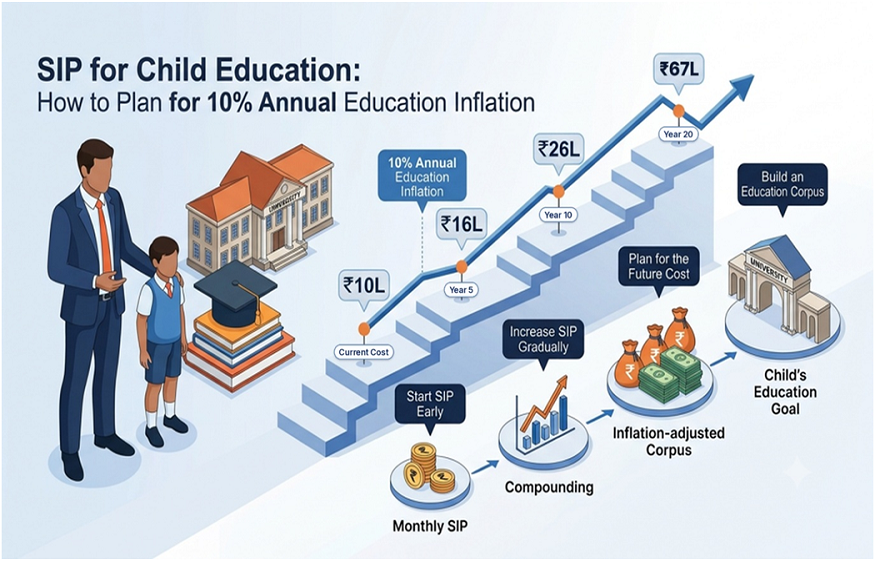
When parents plan for their child’s education, the focus often falls on one question: How much should I invest every month? A better starting point is to understand how quickly education costs may rise.
Education expenses can increase significantly over long periods due to inflation, changing course fees, technology requirements and evolving career paths. For long-term goals such as higher education, assuming a relatively high 10% annual education inflation can help parents build a more conservative financial plan.This is where a disciplined sip for child education can play an important role.
Why Education Inflation Matters
General inflation and education inflation do not necessarily move at the same rate. A degree that costs ₹10 lakh today could cost considerably more when your child is ready for college.
For example, if education costs increase by 10% every year, ₹10 lakh today could become approximately ₹25.9 lakh in 10 years and around ₹67.3 lakh in 20 years.This illustrates why simply looking at today’s education fees can result in an inadequate target.
The actual rate of education inflation will vary by institution, course, location and time period. Therefore, 10% should be treated as a planning assumption rather than a guaranteed future rate.
Start With the Future Cost
Before deciding your SIP amount, estimate the current cost of the education you are targeting.Suppose your child is five years old and you expect higher education to begin when they are 18. You have approximately 13 years to prepare.If the expected education cost today is ₹20 lakh and you assume 10% annual education inflation, the future requirement would be approximately ₹69 lakh.
This ₹69 lakh-not ₹20 lakh, should become the starting point for your investment target.The calculation can be refined further by considering whether you are planning for undergraduate education, postgraduate studies, professional courses or education abroad.
How a SIP Can Help
Once you have a future education target, a SIP can help you invest regularly rather than trying to accumulate the entire amount closer to the admission date.
For example, if your target is ₹70 lakh over 13 years, you can use a sip calculator to estimate the monthly SIP required based on the investment period, target corpus and an assumed long-term investment return. However, projected returns should never be treated as guaranteed. Mutual funds are market-linked, and actual returns can vary. Parents may therefore consider reviewing the SIP periodically instead of setting it once and ignoring it for the next decade.
Increasing the SIP as your income grows can also help. For example, an annual SIP increase can allow your contribution to keep pace with rising income and potentially reduce the pressure of a large fixed monthly investment today.
What About a SIP for Child Plan?
The term sip for child plan is often used broadly for investments made specifically toward a child’s future. However, the objective should remain clear: you are creating a dedicated corpus for a defined financial goal.The investment should therefore be evaluated based on the time remaining, expected education cost, risk tolerance and the importance of the goal-not simply because a product is labelled as a child plan.
For a goal several years away, parents may have greater flexibility in choosing investments with growth potential. As the education date approaches, however, protecting the accumulated corpus becomes increasingly important.
Don’t Ignore the Final Five Years
One common mistake is to focus heavily on accumulation while ignoring what happens as the goal approaches.If your child’s education is only a few years away, a large market decline could affect the amount available when tuition fees are due.As the target date gets closer, parents can review their asset allocation and gradually consider reducing exposure to higher-volatility investments, depending on their circumstances.
The objective is to avoid having the entire education corpus dependent on market performance immediately before the money is required.
Read More: Choosing a Demat Account: What the Right Stock Market Platform Should Offer You
Plan for More Than Tuition Fees
Your education corpus should not necessarily cover tuition alone.Depending on the course and location, consider accommodation, books, technology, transportation, application fees, travel and other associated expenses. If studying abroad is a possibility, currency movements can also affect the eventual requirement.
It is also sensible to maintain a separate emergency fund so that an unexpected family expense does not force you to withdraw the education corpus prematurely.
Review Your Child Education Goal Regularly
A sip for child education works best when it is connected to a realistic future-cost estimate rather than an arbitrary monthly amount.
A simple framework is:Current education cost → 10% inflation assumption → Future education cost → Investment period → Required SIP → Periodic review
Read More: Best Fire-Resistant Jewellery Safe in India – A Complete Buying Guide for Jewellery Retailers
Education inflation may ultimately be higher or lower than 10%, and investment returns will fluctuate. Therefore, review the target at least once a year and whenever there is a significant change in your income, education preferences or the expected cost of the course.Starting early gives parents more time to benefit from disciplined investing and compounding. More importantly, estimating the future cost realistically can help ensure that the SIP is designed around the child’s actual education goal rather than today’s prices.
This article is for educational purposes only and should not be considered investment advice. Inflation and investment returns are not guaranteed, and actual education costs may vary significantly by course, institution and location.